


Blog 20 May 2026
From Paper to Practice: How to Make Long-term Strategies Work
Development strategies can no longer treat climate change as a side issue. Impacts from disasters and slow-onset stresses are already affecting productivity, infrastructure, health, and livelihoods across the world, threatening countries’ development priorities. At the same time, many countries have made international commitments that they need to achieve in a way that supports their development objectives.
Fortunately, efforts to create resilient low-emission economies also generate enormous opportunities. Cleaner technologies can reduce air pollution and its health burden. Better land and water management can keep agriculture productive. And with the right policies, the shift to resilient, low-emission development can create jobs, support firms, and open new markets.
Long-Term Climate Strategies (LTSs) help countries capture these synergies. Done well, an LTS aligns a country's long-term vision for growth with a climate-resilient, low-emission development trajectory, ensuring that infrastructure investments, fiscal decisions, and sectoral policies are pulling in the same direction.
Yet too often, LTSs remain aspirational. They often do not translate into the daily decisions that shape development planning, and the financing decisions that shape a country's future. And when they fail to influence firms’ choices on R&D, technologies, and investments, they miss a major opportunity to deliver growth and jobs.
To ensure LTSs deliver benefits for countries, firms, and people, we are publishing today a practical framework to guide countries through the formulation of an LTS that is institutionalized, and therefore implementable and financeable. The framework builds on concrete experience supporting LTS processes in five countries – Dominican Republic, Jordan, Lao PDR, Türkiye and Uzbekistan - and interviews with many practitioners, drawing lessons and best practices from these real-world cases.
Institutionalization cannot be an afterthought
Institutionalization needs to start at the beginning of the LTS process, not at the end. This means embedding the strategy into the legal, political, and budgetary fabric of a country so it survives political cycles, influences budget decisions, and shapes investment choices.
It means an LTS is not a standalone document owned by a single ministry, but a living commitment, anchored in law or regulation, aligned with national development plans, and backed by a broad coalition across government, civil society, and private sector actors. It should also inform the trade-offs governments make every day as they pursue growth and resilience while responding tothe unavoidable crises.
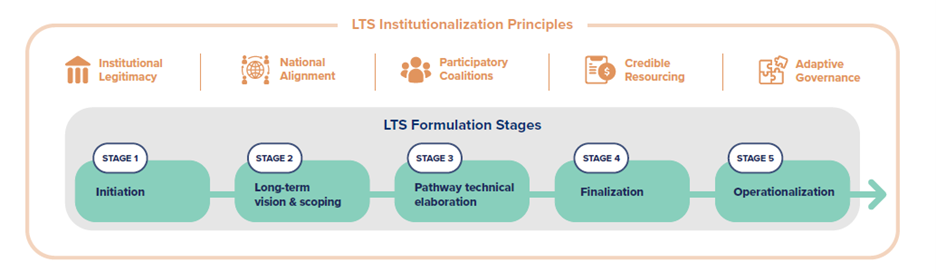
Our framework identifies five core principles of institutionalization: institutional legitimacy and national alignment, participatory coalitions, credible resourcing, and adaptive governance. It offers concrete examples of how these principles have been implemented in practice, acknowledging that it will look differently in countries with different levels of institutional capacity, technical expertise, and political economy.
The institutionalization principles are embedded in a five-stage LTS process that can be adapted to most contexts: (1) Initiation; (2) Long-term vision and scoping; (3) Pathway technical elaboration, (4) Finalization, and (5) Operationalization. Built on practical experience in diverse countries, the framework offers practical tools and methods for each stage.
The Ministry of Finance as a Key Partner
Particularly important in the LTS formulation and institutionalization is the early and substantive involvement of the Ministry of Finance. This requires more than just assigning a climate focal point. The teams responsible for budgeting, managing the public debt, allocating resources across ministries, tax collection, and forecasting macroeconomic trends need to contribute, inform, and own the strategy.
When engaged early, Ministry of Finance participation can ensure that the strategy is realistic from a macroeconomic and financial perspective, and is aligned with other important policy priorities, making it easier to consider trade-offs.
At the implementation phase, Ministry of Finance involvement makes it easier to reflect climate priorities in fiscal frameworks, expenditure plans, and public investment decisions. Without participation of the Ministry of Finance at the design phase, it is unrealistic to expect that a strategy requiring changes in public expenditure or budgetary allocation can be quickly implemented.
Finally, the Ministry of Finance can also help identify financing solutions, from estimates of the realistic volume of public and private finance to defining more specific instruments. This can take the form of the right Key Performance Indicators for sustainability-linked finance or the amount of emission reductions that can be exported to generate revenues from international carbon markets.
LTSs as a scalable and replicable solution
This LTS framework reflects the World Bank Group’s role as a Knowledge Bank, capturing lessons from country engagement, and helping scale what works. In climate and development, that matters because countries need practical approaches they can adapt to their own institutions, markets, and labor needs.
By codifying the lessons learned from LTS processes across multiple countries into a practical methodology, this framework becomes a blueprint that others can adapt. Its core message is simple: institutionalization should start from existing country governance systems and that a climate strategy needs to be integrated within a country’s broader economic and development landscape.